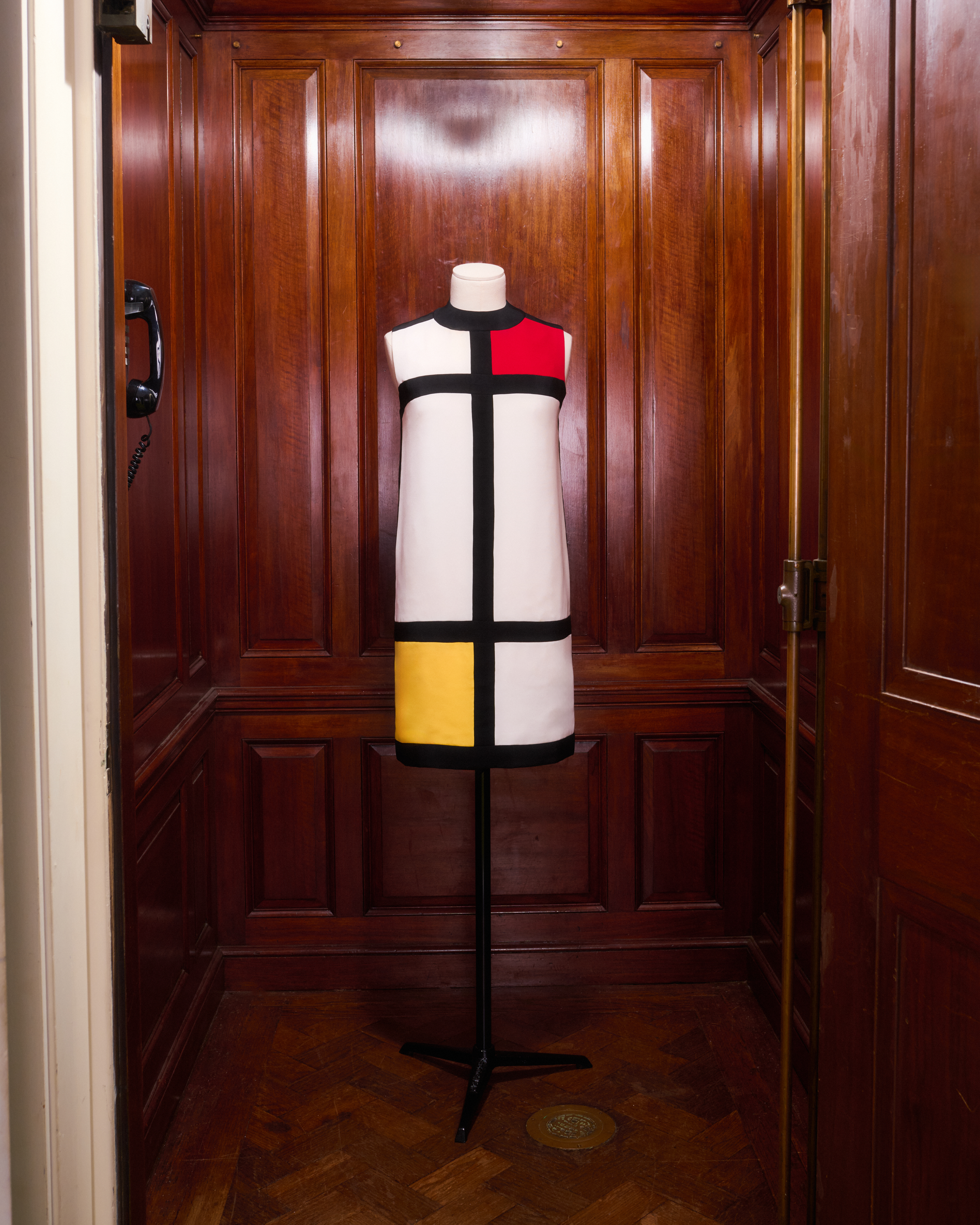
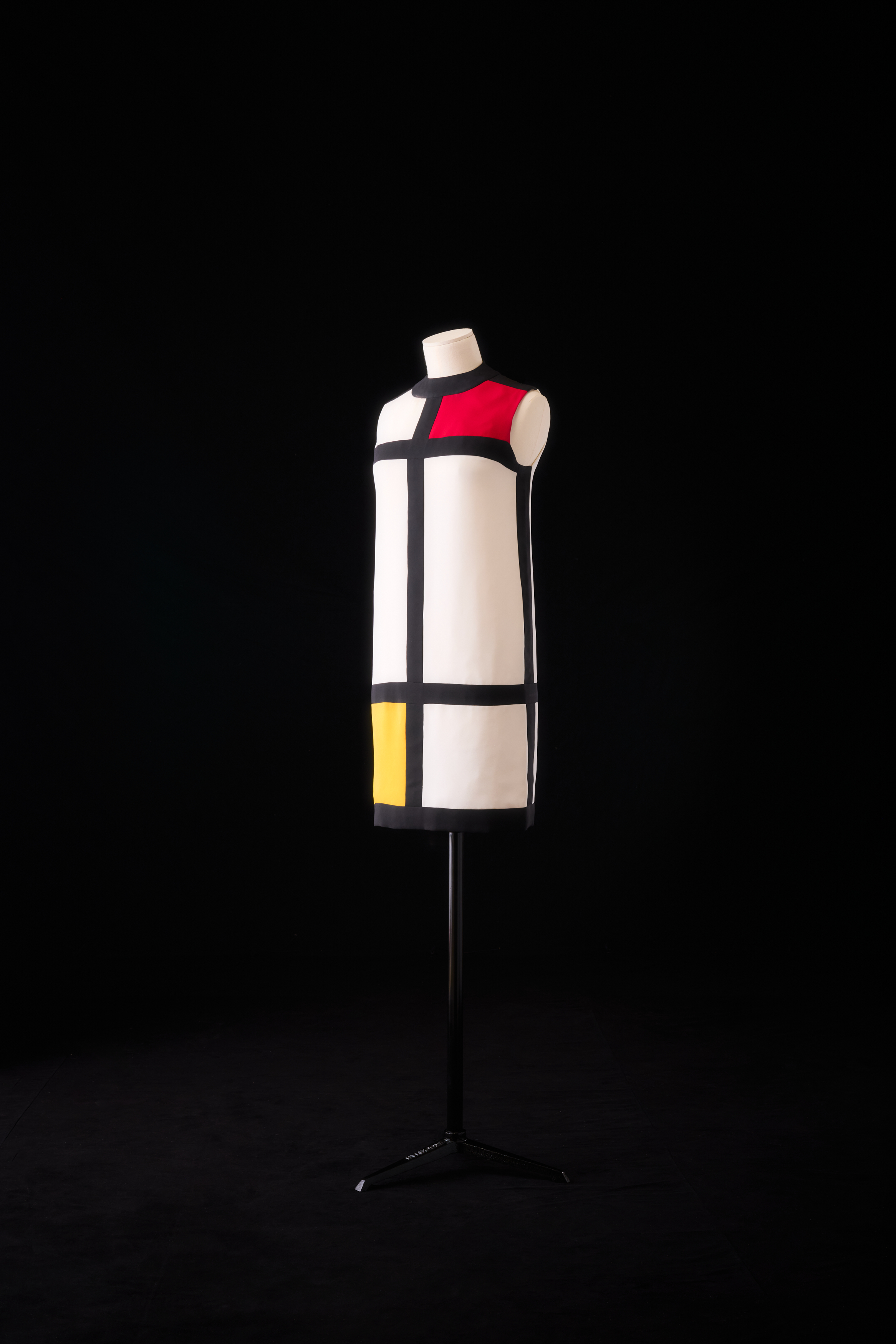
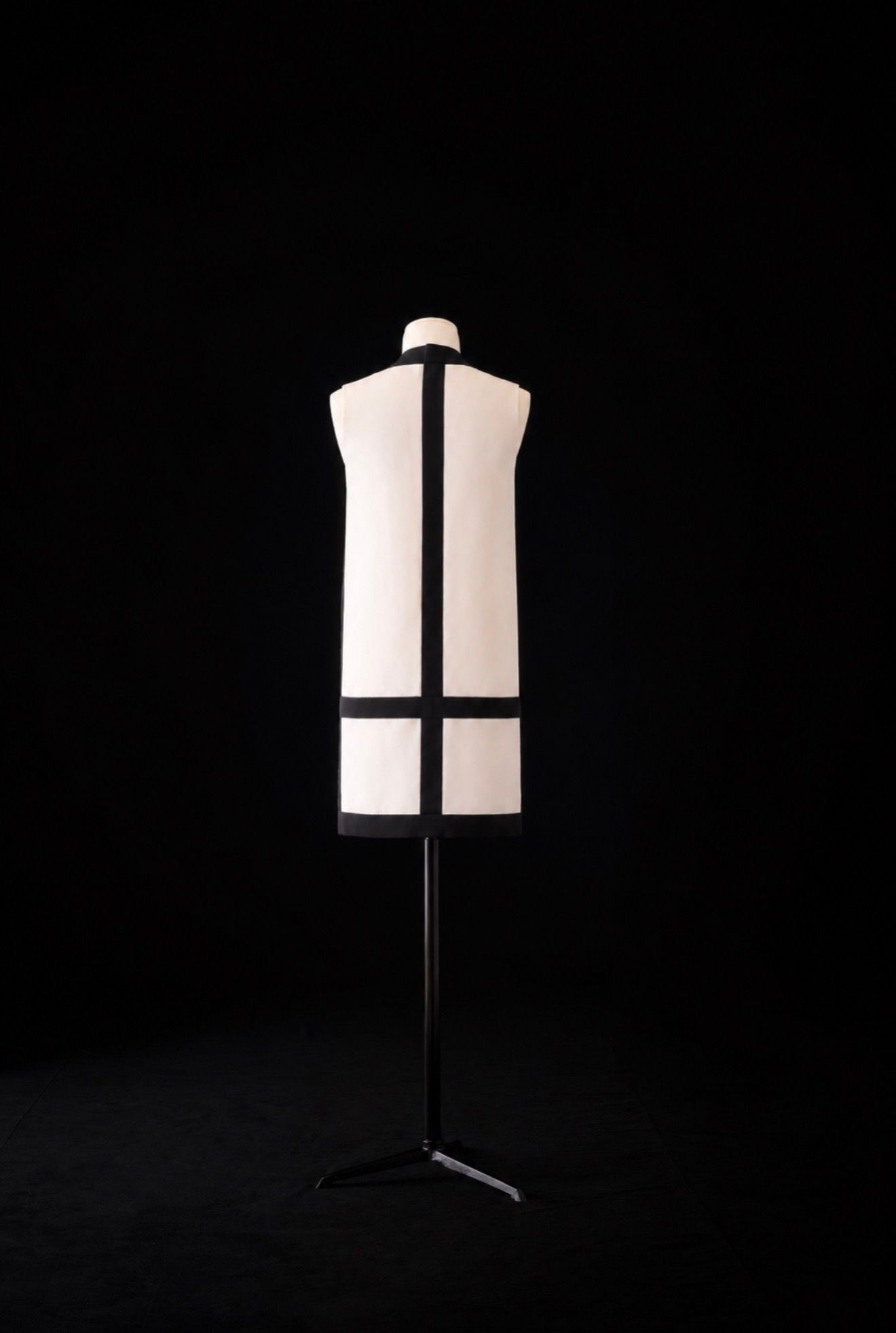
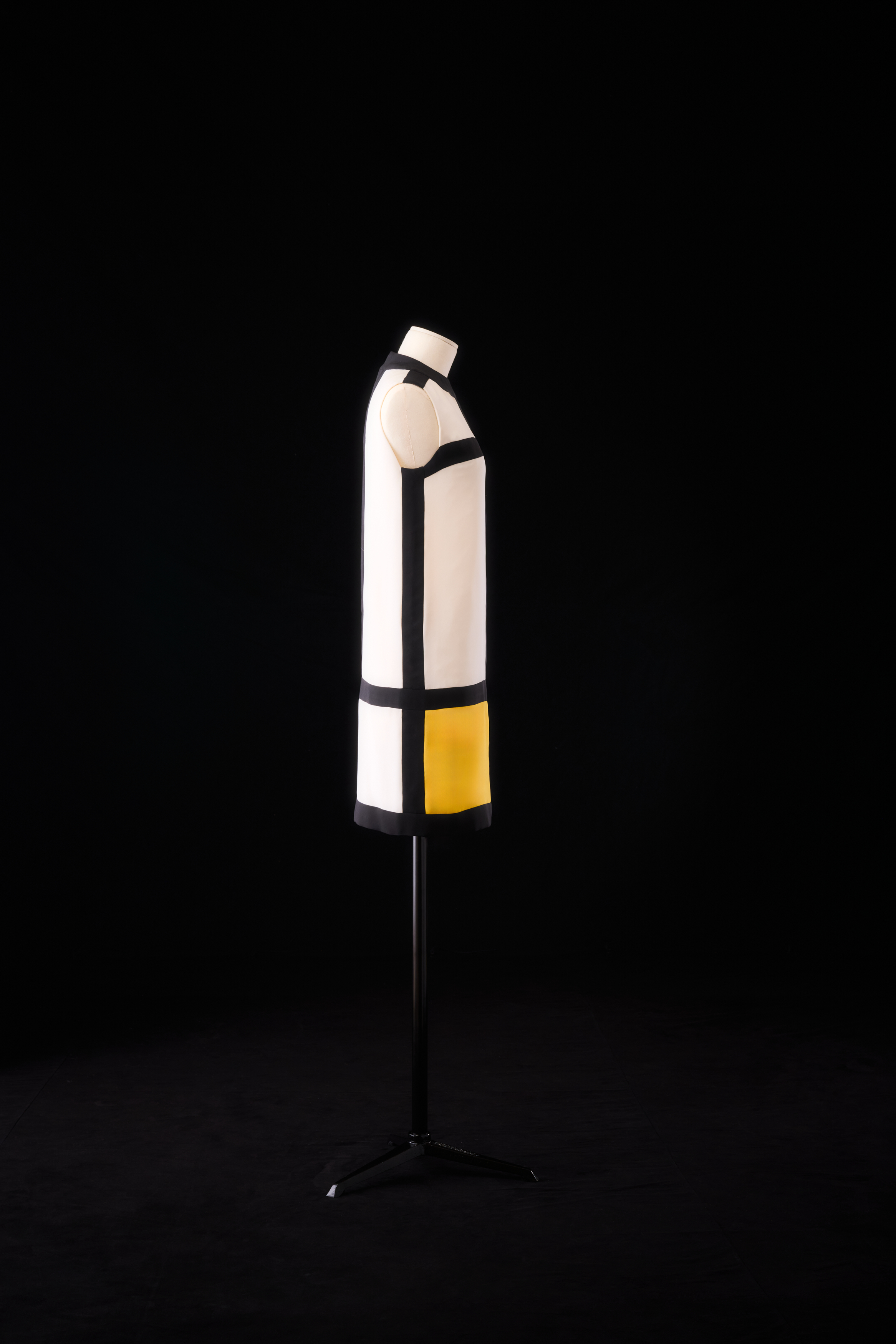
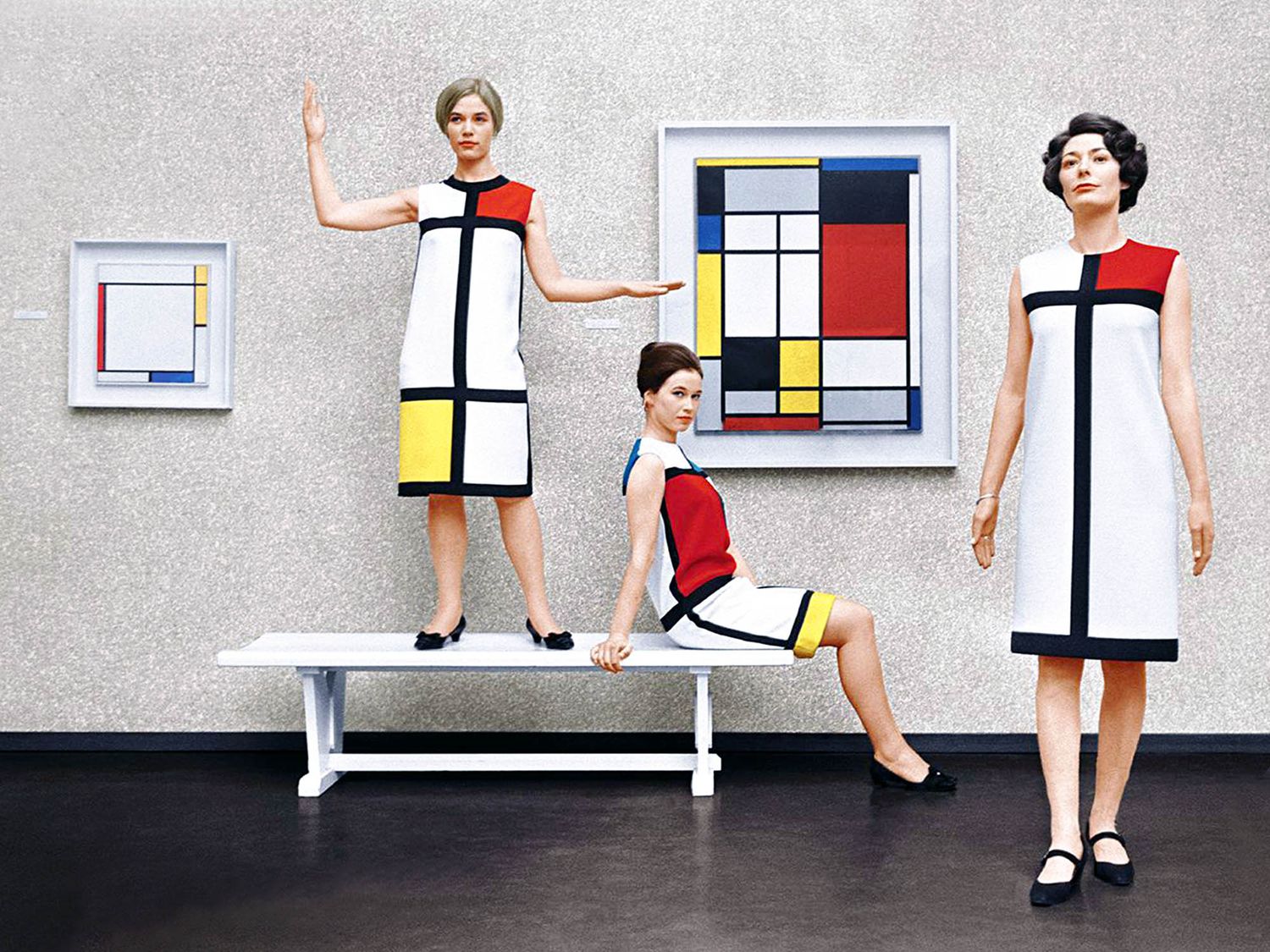
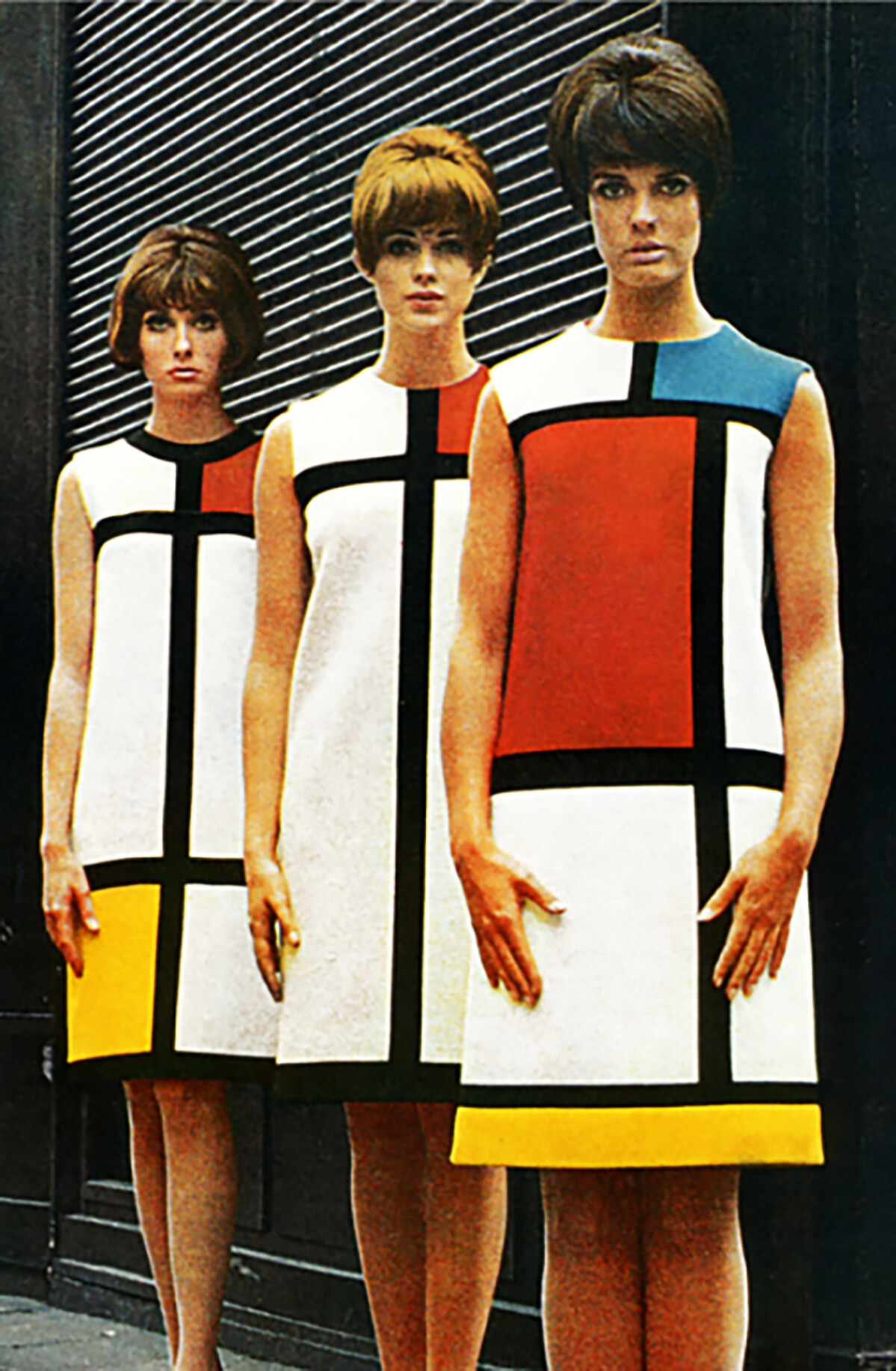
Cocktail dress made from Abraham of Switzerland and Bianchini Ferier silk crepe de Chine. On the front there are red and yellow gaberdine color block panels on an ivory ground fabric. Around the blocks are black stripes of lattice banding. The back has no color and is made from the same ivory fabric. The lining is an ivory silk. There is a zipper closure at the center back.
Royal family of Belgium
Private collection, Belgium (gift of the above)
Acquired from the above by the present owner
Victoria and Albert Museum, London (same dress)
Similar dresses are housed in collections of:
The Metropolitan Museum of Art, New York
Musée Yves Saint Laurent, Paris
Other models of the dress were photographed by David Bailey, Irving Penn, Richard Avedon and countless others.
London, Victoria and Albert Museum, Fashion: An Anthology by Cecil Beaton, October 13, 1971 - January 16, 1972.
London, The Barbican Centre, The Vulgar: Fashion Redefined, October 13, 2016 - February 5, 2017.
Paris, Musée Yves Saint Laurent, Permanent Collection, February 12, 2019 - January 19, 2020.
C. Beaton, and M. Ginsburg, Fashion : An Anthology by Cecil Beaton, London: Victoria and Albert Museum, 1971, p. 56, #390
F. Muller and F. Chenoune, Yves Saint Laurent, New York: Abrams Book, 2010, p. 315
N. J. Troy, and A. M. Tartsinis. Mondrian’s Dress: Yves Saint Laurent, Piet Mondrian, and Pop Art, Cambridge: The MIT Press, 2023, pp. 10 & 67
J. Clark, A. de la Haye, and J. Horsley, Exhibiting Fashion: Before and After 1971, New Haven and London: Yale University Press, 2014, pp. 114, 116
C. Wilcox and J. Lister, V&A Gallery of Fashion, London: V&A Publishing, 2013, p. 137, #142
Another Mondrian dress was published in:
F. Muller, and C. Ishikawa, Yves Saint Laurent: The Perfection of Style, New York: Rizzoli, 2016, pp. 138, 139
P. Bergé, Universe of Fashion: Yves Saint Laurent, New York: Universe Publishing, 1997, pp. 32, 33
Materials: silk crepe with silk crepe lining
Measurements taken flat:
Shoulder to shoulder (flat): 18 ¼”
Bust: 36 ½”
Hips: 36”
Length of zipper closure: 18”
Neckline opening (flat): 4 ¾” ; 12 ½” in the round
Center front length neckline to hem: 33 ¾”
Center back length neckline to hem: 35 ½”
Label stitched onto the side: labelled and numbered: ‘Yves Saint Laurent Paris 10371’
The Mondrian Dress was a big-bang moment in fashion—one that radically expanded what a dress could be.
With these dresses, Yves Saint Laurent broke from the traditional rules of fashion, in which the designer “composed” with the human body to generate form, color, and structure. Instead, he imported the outside world directly onto the dress, bringing with it an entirely different set of rules: those of modern art, abstraction, and culture.
The woman wearing it was no longer merely dressed or “packaged.” She became a statement, a banner, and ultimately an agent of influence. The dress transformed the body into a surface through which ideas could circulate.
The liberation of women in the 1960s is inseparable from the radical transformation of the way women dressed, and perhaps no single dress embodies that moment more powerfully than Saint Laurent’s Mondrian Dress. It did not simply reflect a changing world; it demonstrated that fashion itself could become one of the forces changing it.
Only a handful of Mondrian dresses are known to survive today, with most held in major museum collections. Another example of this particular motif is preserved in the Victoria and Albert Museum in London.
It has been decades since a Mondrian Dress of this significance has appeared at auction, making this an exceptionally rare opportunity to acquire one of the defining objects of twentieth-century fashion.
