In 2017, Matt Hall and John Watkinson, software developers and founders of the New York-based company Larva Labs, created a program that would generate thousands of unique digital characters, each linked to a smart contract on the Ethereum blockchain. These characters, ranging from humans to zombies, apes, and aliens, became known as CryptoPunks, a crude yet eclectic cast of misfits that posed a profound question: Could a few lines of code translate into meaningful ownership and authenticity in art?
Today, the launch of CryptoPunks is seen as a watershed moment in digital art and the history of NFTs (non-fungible tokens). CryptoPunks became the blueprint for the NFT movement, reshaping the digital art market and challenging traditional notions of “ownership” in art.
Despite their success with CryptoPunks, one detail evaded Hall and Watkinson. Although discussions of permanence and provenance on the blockchain were central to the project, the actual artwork for CryptoPunks was stored off-chain as an external image file. Determined to create algorithmically generated art that was entirely self-sustaining—independent of platforms, marketplaces, or external websites—they conceived the idea for Autoglyphs.
However, one major obstacle stood in their way: the Ethereum blockchain was not designed to store large amounts of data. Despite these technical limitations, Hall and Watkinson released Autoglyphs in April 2019, marking the first fully on-chain generative art project.
For Hall and Watkinson, the development of Autoglyphs was a return to the roots of the digital art movement. “We definitely needed to clamp down the parameters pretty hard because of the technical requirements, but we’d been getting into the early pioneering digital art of the ’60s and early ’70s stuff," Watkinson explained in a 2019 interview with Artnome. "It's definitely an homage to Michael Noll and Ken Knowlton and that kind of stuff, which we really love. Only once we got to this digital art world via the CryptoPunks did we really realise how much of all this stuff had been explored in the ’60s. It’s almost humbling how much ground was covered so quickly in digital art in the ’60s and early ’70s.”
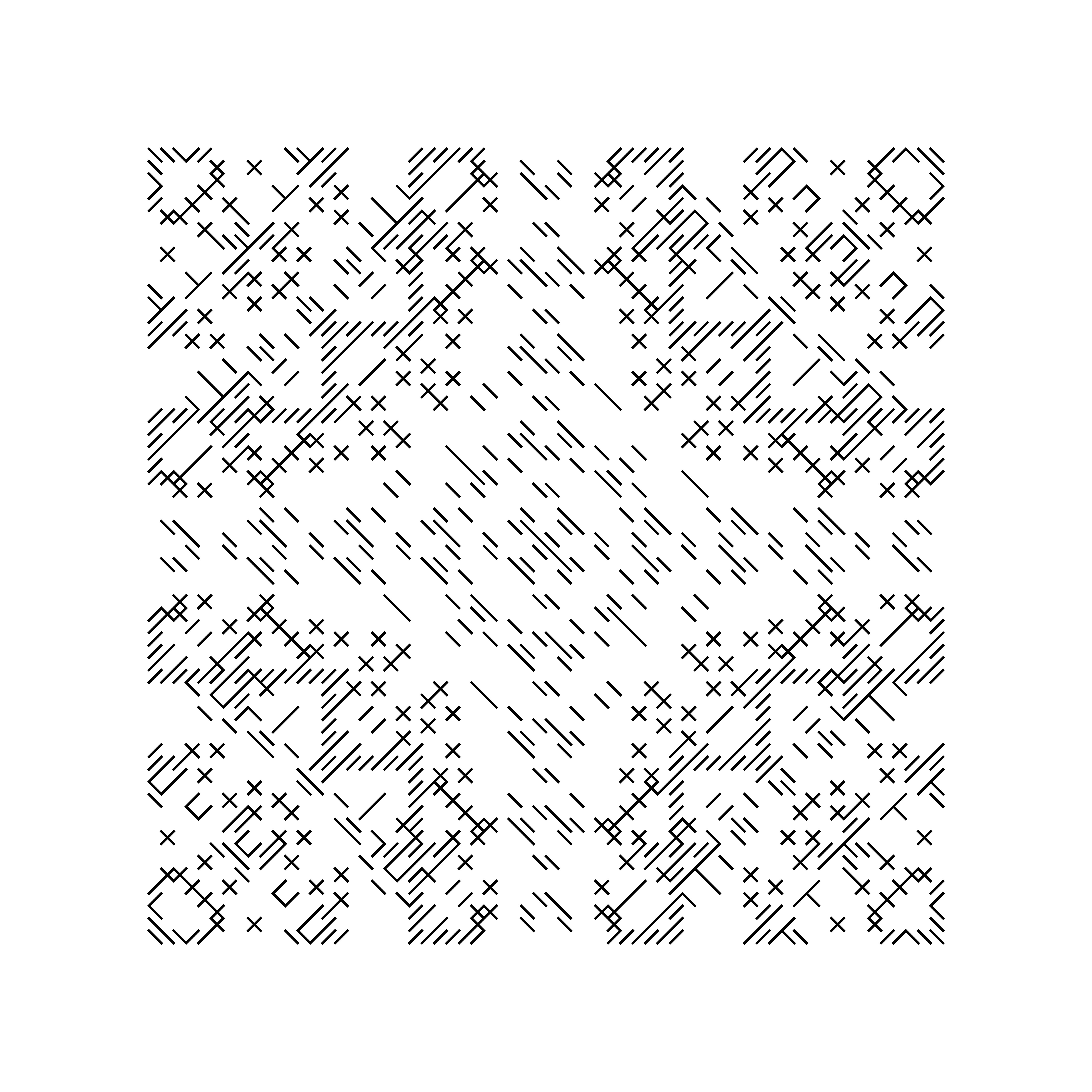
The Autoglyphs software was designed to produce 512 unique artworks, each composed of a defined set of ‘glyphs.’ Each glyph is represented by ASCII characters (such as x, /, , +, |, and –). Across the collection 10 distinct series of glyphs exist. These series, known as Symbol Sets, are the building blocks which allow the algorithm to generate a unique, abstract visual pattern that comprises the artwork for each Autoglyph. For die-hard collectors, acquiring all 10 symbol sets is the holy grail of crypto collecting, and, due to the rarity of some of the sets, a difficult task to achieve.
Composed of black-and-white lines, circles and squares, the resulting image is both minimal and conceptual in nature. And, despite representing another landmark moment in digital art history, Autoglyphs remain deeply rooted in the art of the not-so-distant past — a natural stepping stone in the forward-moving trajectory of art history.
Though the visual style may evoke comparisons to Piet Mondrian, Autoglyphs are inextricably linked to the conceptual art of Sol LeWitt. While the generator itself exists within the smart contract, allowing the artwork to fully live on-chain, the smart contract also provides drawing instructions that allow owners of Autoglyphs to recreate their glyph outside of the blockchain.
Though these instructions arose out of necessity to generate image files for user convenience, in their interview with Artnome Watkinson explained, “…in the source code for the actual smart contract, if you scroll down a little bit below that big ASCII art ‘Autoglyphs,’ you'll see that there are these little instructions. For every ASCII art character, it tells you how to draw it. We generate image files that way. But the idea is that anyone can generate it—kind of like a Sol LeWitt instruction set for creating a drawing.”
Like LeWitt, who relied on others to execute his conceptual works based on written instructions, Larva Labs removed the artist’s hand from the creative process, prioritising the idea of the artwork over the act of creation itself.
The genesis for the idea stemmed from the duo encountering LeWitt’s work at the Whitney Museum of American Art. “There was this big Sol LeWitt piece, and they were explicit about how this piece had been executed by an assistant at the gallery, but that's in keeping with the intention of the artwork and the instructions of the artist,” Hall expanded to Artnome. “We thought that was good, it was perfect, because we can't do a lot of things we want to do directly on the blockchain, but we can have the spirit of it be completely self-contained.”
Autoglyphs mark a significant evolution in the history of art, blending the minimalist rigour of 20th-century conceptualism with the boundless possibilities of 21st-century technology. As the first fully on-chain generative art project, they serve as a bridge between past and future, anchoring digital art in the traditions of conceptual pioneers while charting a path forward for artists working at the intersection of art and code.