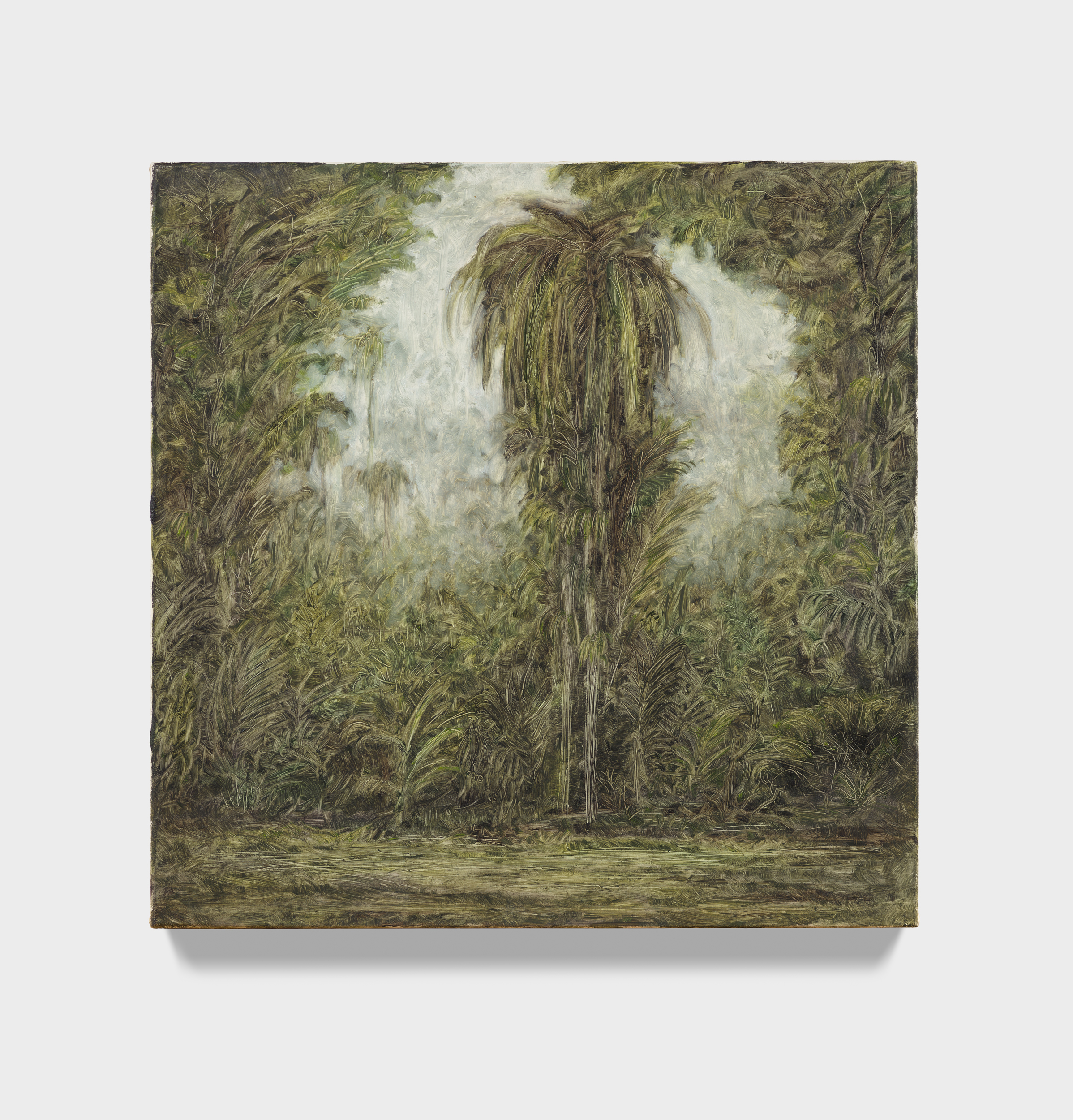
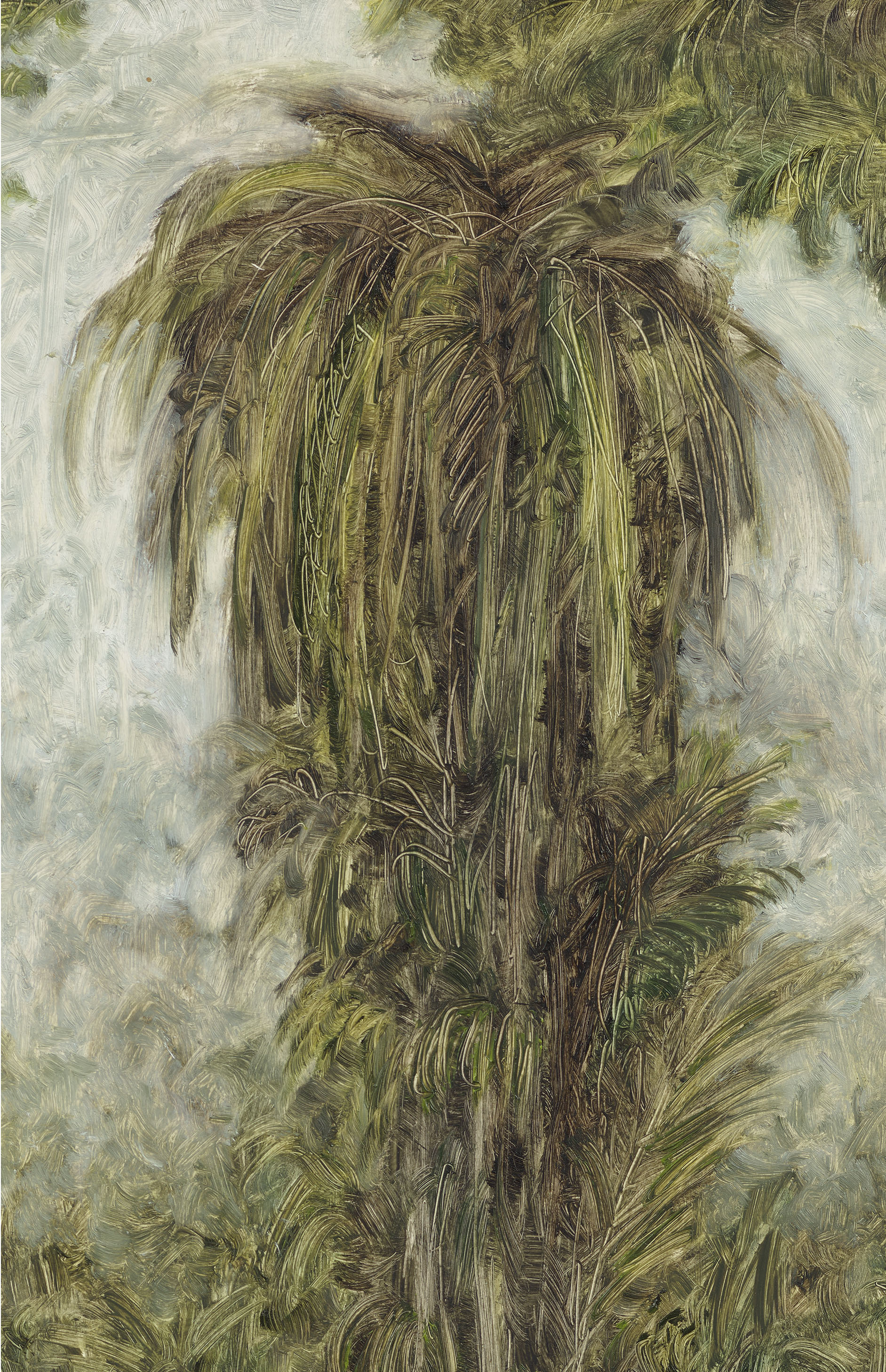
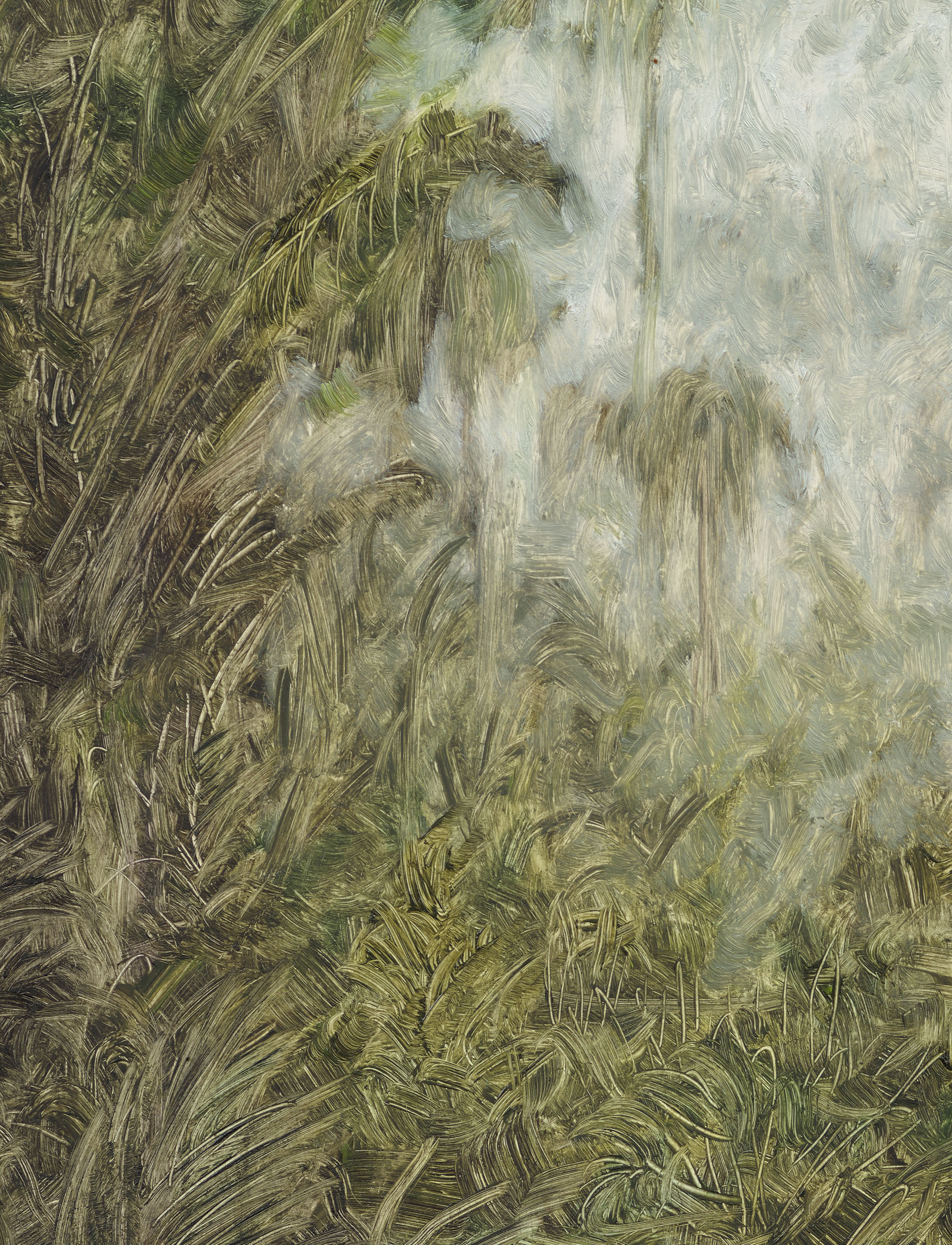
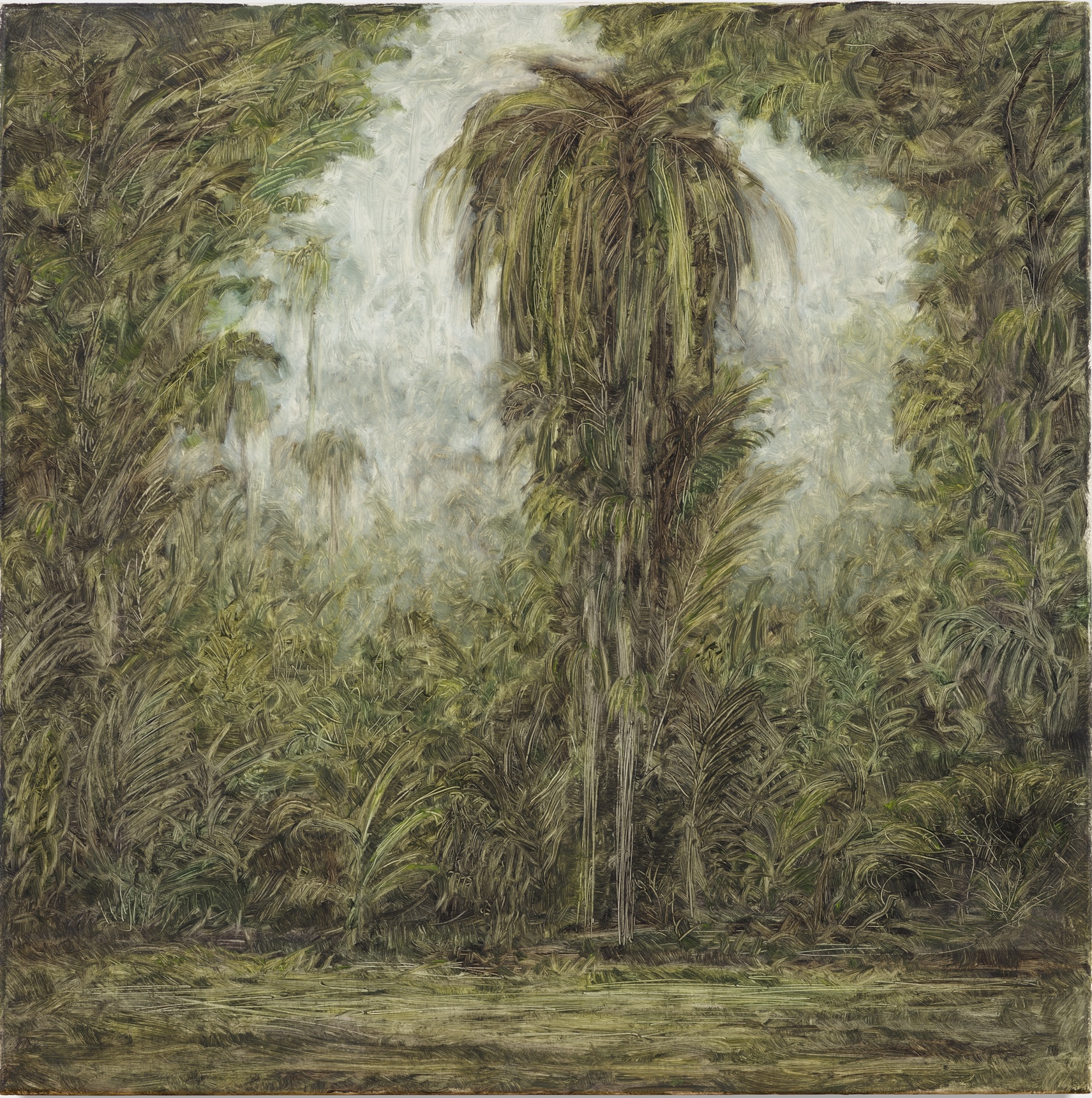
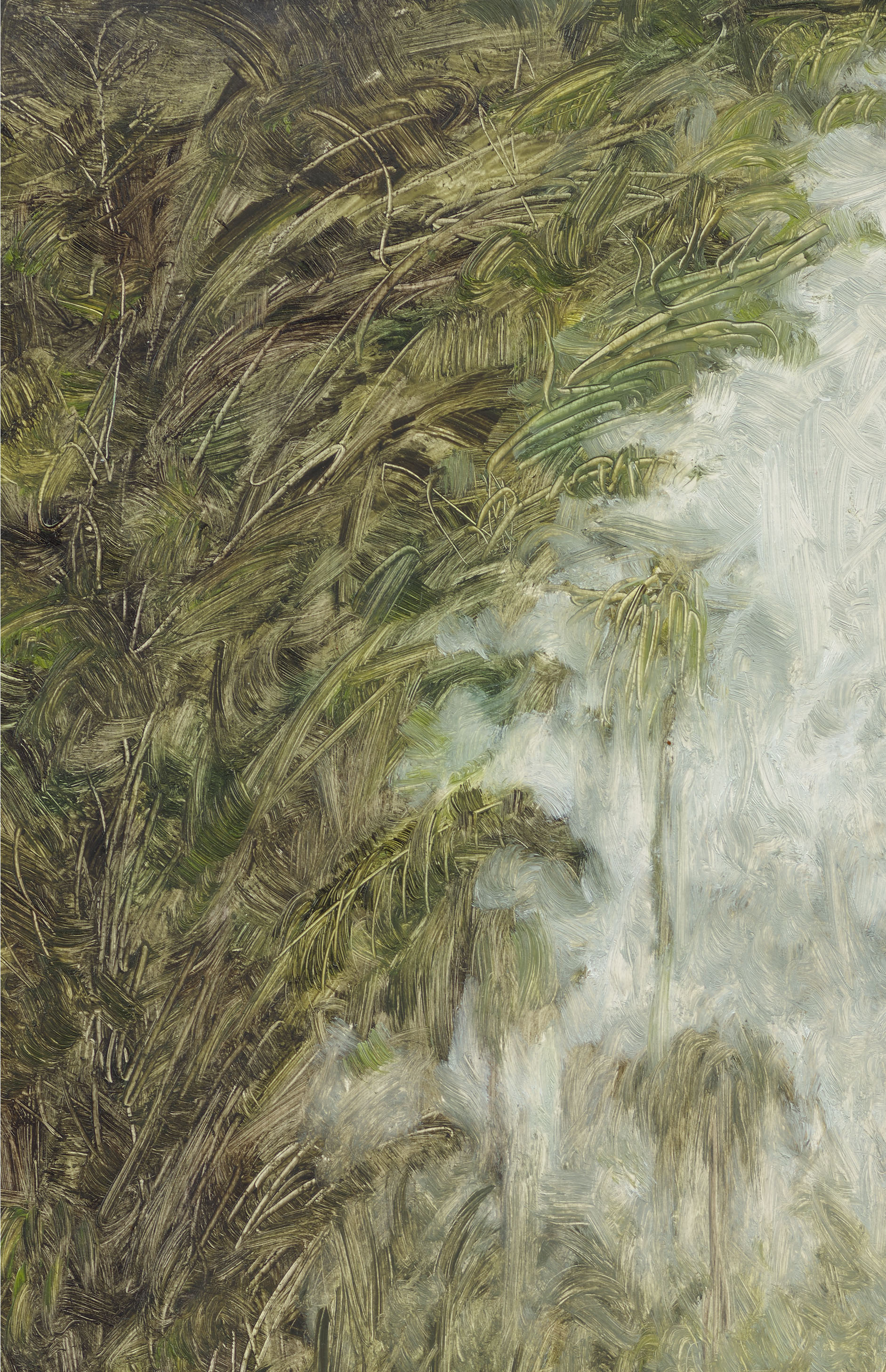
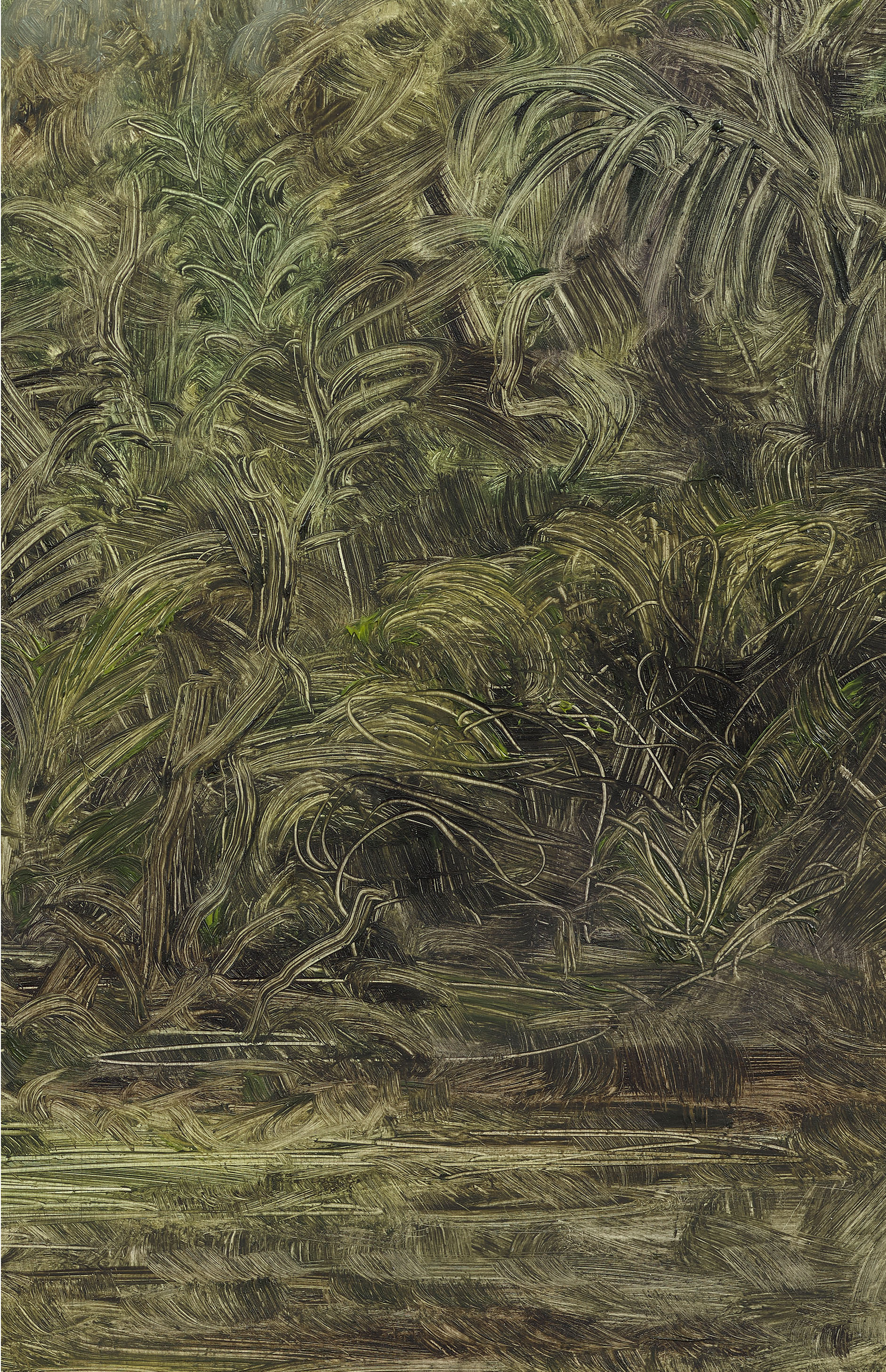
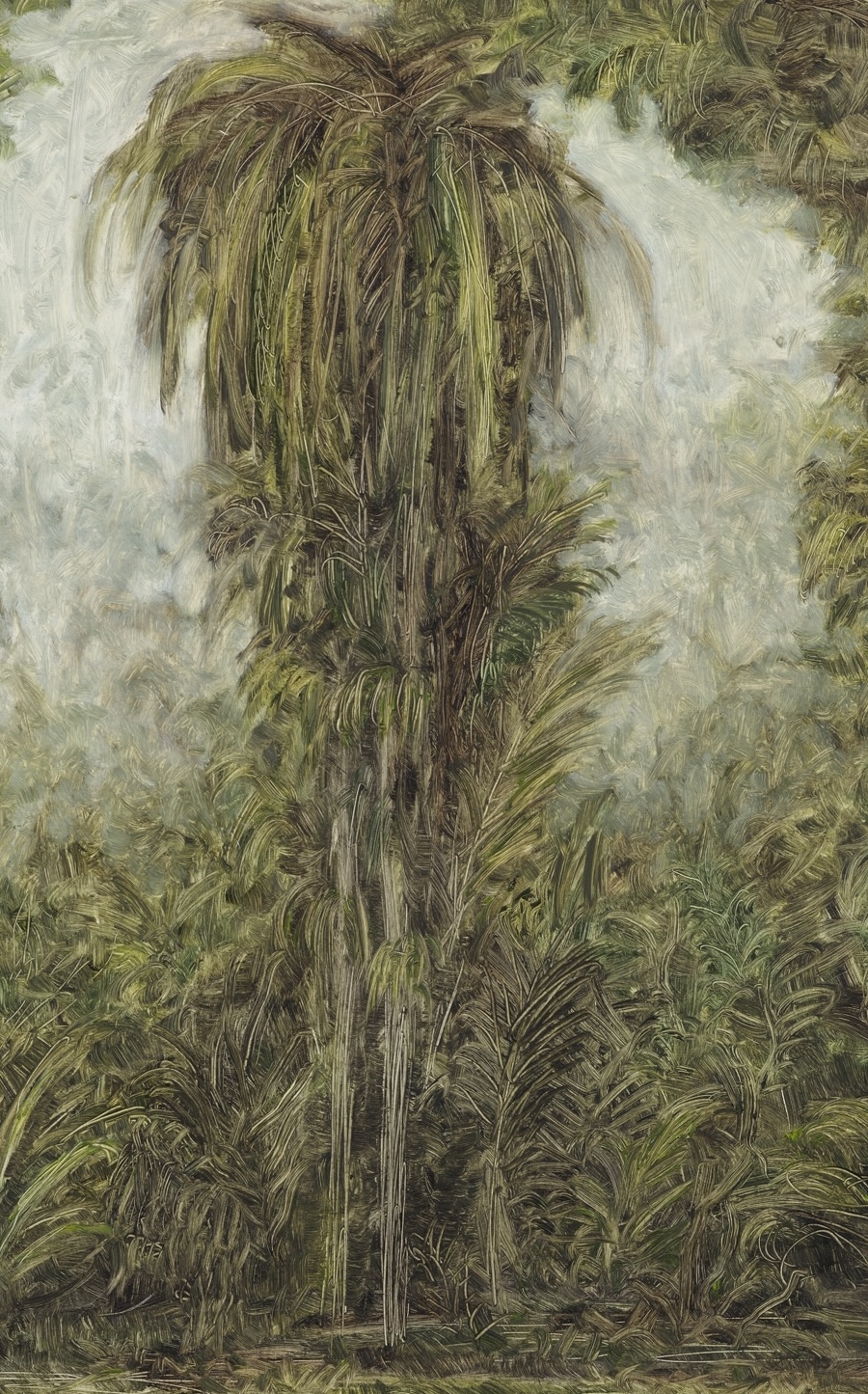
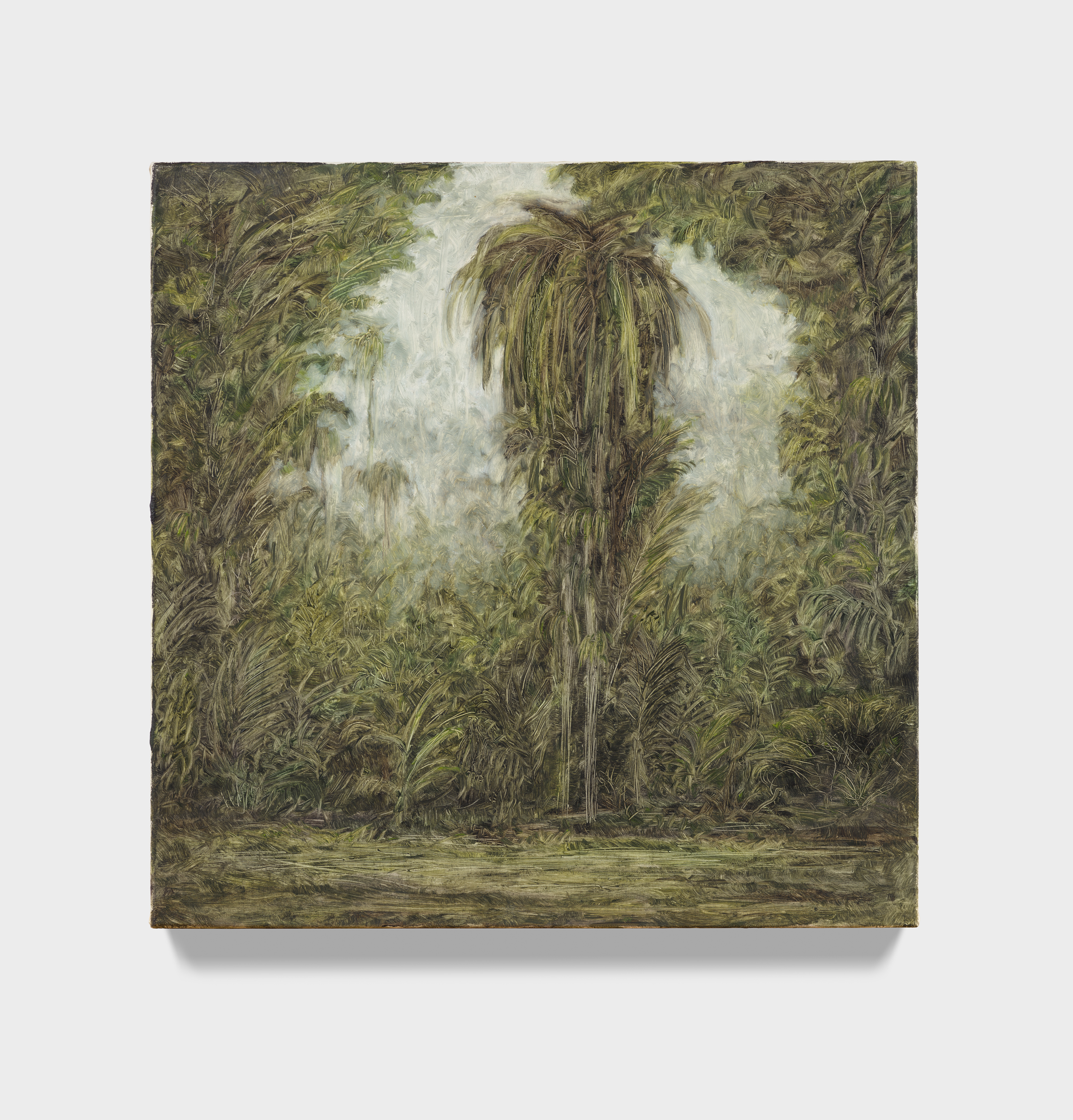
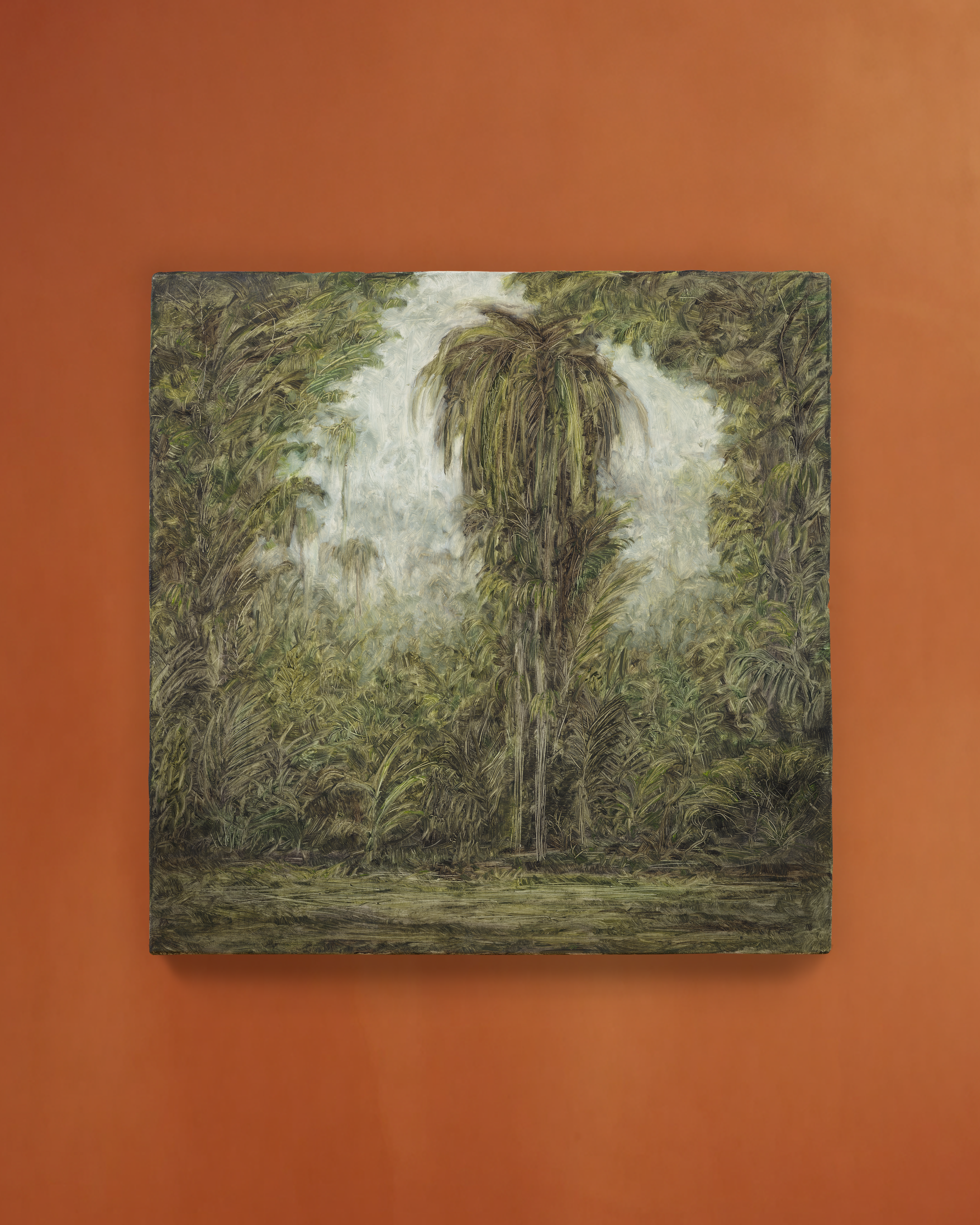
The genesis of Lucas Arruda’s jungle paintings is rooted in the artist's formative memories of the verdant foliage outside his childhood bedroom window near São Paulo. Created on prepared surfaces using a reductive painting process, the impression of light is achieved through the careful subtraction of pigment, heightening the sense of both presence and mystery. The jungles seem at once impenetrable and infinite, dense with vegetation yet suggestive of boundless space—a paradox that mirrors the complex interplay between memory and imagination in Arruda’s work.
Having studied painting for most of his life, Arruda belongs to a new generation of Brazilian artists aiming to reintroduce painting into an art scene long dominated by conceptual and video art. “By the time I got to college, I was already on a path towards painting, which was unusual in that context,” Arruda has explained. “I was part of a generation in Brazil that reclaimed painting in around 2005, almost as a statement, as if to say: why not painting? But I consider myself an artist who works with paint, rather than a painter. At the same time, whichever medium I choose to work in is informed by painting. Even my works that seem like classic oils on canvas are more like installations that happen to use the medium of paint.” This fluid approach allows Arruda to push the boundaries of traditional painting, transforming familiar forms into portals of emotion and myth.
For Arruda, the quasi-mythical scenery of the Brazilian rainforest evokes a tension between reality and human imagination. Towering and impenetrable yet suggesting an infinite space beyond their physical bounds, his jungles become sites of power and enlightenment as much as they are harbingers of darkness and uncertainty—a place where one can be lost to the world and, perhaps, find themselves again. Reflecting on this duality, Arruda told Hans Ulrich Obrist in 2018, “I mostly paint imagined horizons. But, in the jungle’s case, there is a less elusive connection. I have a house in the jungle near São Paulo where I go all the time. I guess jungles hold a particular mystery, a sense of imminence—as if something is always about to happen. And for these kinds of paintings I often evoke a character: Curupira. He is a mythological character with inverted feet, a young trickster who protects the jungle. Like Hermes, or Loki, he fools us in order to prevent human connections to the forest. You never know what to expect from Curupira: he might help you or just as easily kill you. The legend says that he is the embodiment of the forest, and I find this especially compelling. The jungle is the only verticality in my work, which somehow grounds it. But Curupira is there to mess around with this idea.”
While Arruda’s work has often been linked to the Romantic landscapes of Caspar David Friedrich and J.MW. Turner he resists being labeled a landscape painter. Instead, he emphasizes that his landscapes are not direct representations of any real place but rather imagined spaces rooted in memory, myth, and sensation. “If anything,” he has said, “I identify more with Morandi, in the sense that I always use the same structure—a landscape with a horizon line. There’s a combination of mathematical and metaphysical impulses in my work. In a way, the only reason to call my works landscapes is cultural: it’s simply that viewers automatically register my format as a landscape, although none of the images can be traced to a geographic location. It’s the idea of a landscape rather than a real place.”
His jungles, then, are not bound by geography but emerge as a conduit for his broader painting practice—spaces where imagination and memory intertwine and where figures like Curupira disrupt the notion of stability. The rainforest, for Arruda, is both a deeply personal and a mythic realm, where the seen and unseen converge, grounding his work in both the familiar and the fantastical.